

Battery Swap Out Technologies
Battery
Swap Out
Technologies
Electrification solutions for assets on the move
Battery Swap Out Is The Future
Renewables are cheaper
Renewable energy is more cost effective than legacy technology for many applications. The challenge is now how to best utilise and manage their intermittent nature.
Storage holds the key
Battery technology has improved and prices have dropped. They are being deployed at an ever-increasing rate to accelerate the use of renewables and solving transportation challenges.

The challenge
High capex, inability to leverage cheap renewable energy, complex power infrastructure, and disruption to operations is delaying the electrification of the rail sector.
Our Product
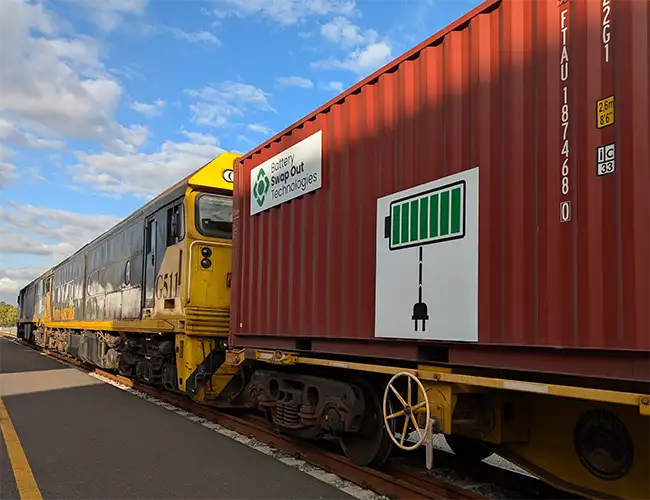
Core Technology
This short video shows BSOT’s core technology in action.
Advantages of working with BSOT
- Deploy your capital more effectively by investing in your primary business operations.
- Provide certainty in your energy costs and minimise exposure to volatile fuel prices.
- Limit operational disruptions and impact to infrastructure with our small footprint and rapid battery exchange system.
- Lower ongoing maintenance expenses by shifting responsibilities away from internal assets.
- Avoid risks associated with rapid advancements in energy technology and innovation.
- Reduce your carbon footprint and assist in meeting regulatory requirements.

Our team

Our leadership brings deep expertise in governance, capital, and execution. With decades of experience across start ups, asset management, IP, and regulation, we deliver from concept to commercialisation.
Backed by top-tier engineers and strong industry networks, we scale efficiently and manage risk.

Developments in Battery Swap
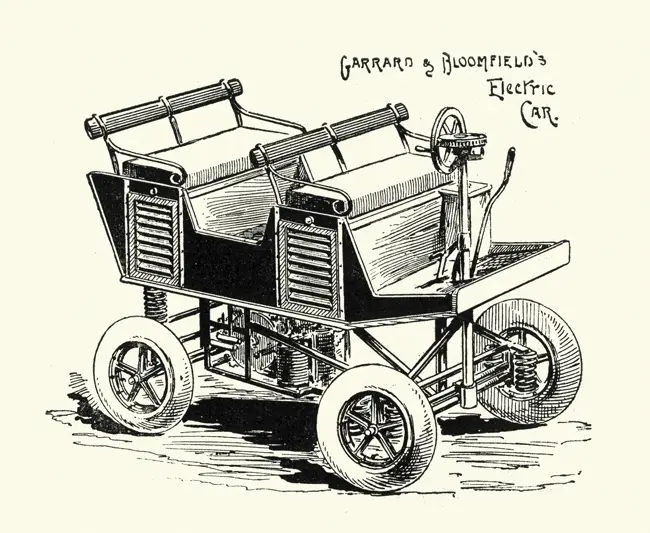
It’s nothing new
The concept of an exchangeable battery service was proposed as early as 1896.
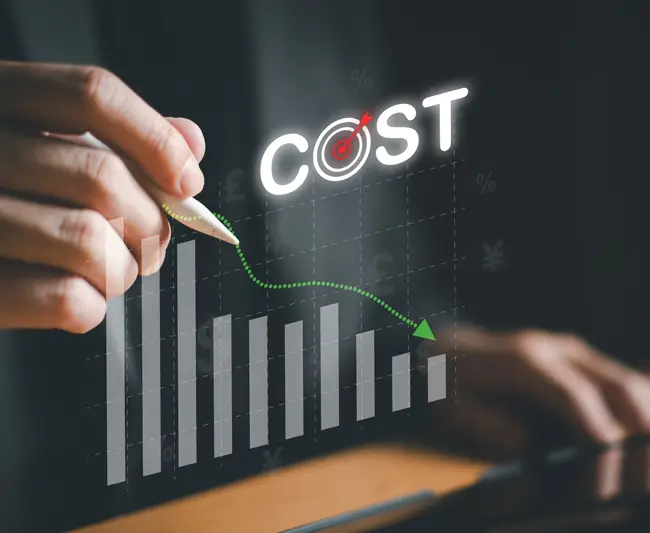
Low battery prices
They keep dropping and don’t show any signs of slowing down.
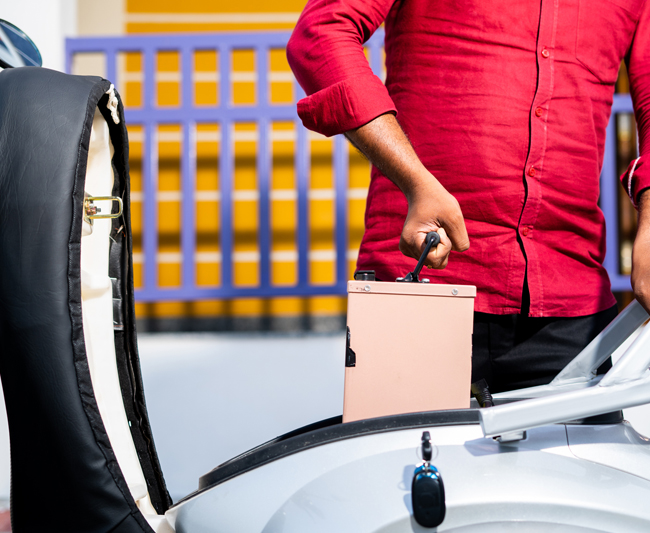
Battery swap for Scooters
Find out why battery swapping works for scooters.
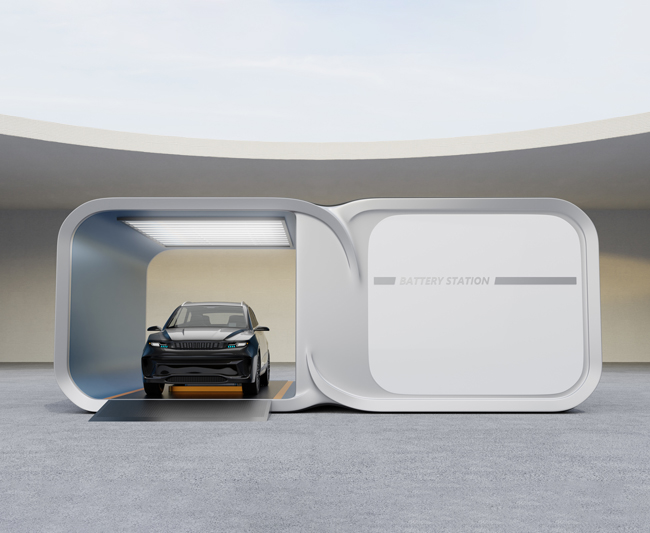
It's the next big thing
The world’s two largest battery manufacturers, CATL and BYD, recently launched battery swap solutions.
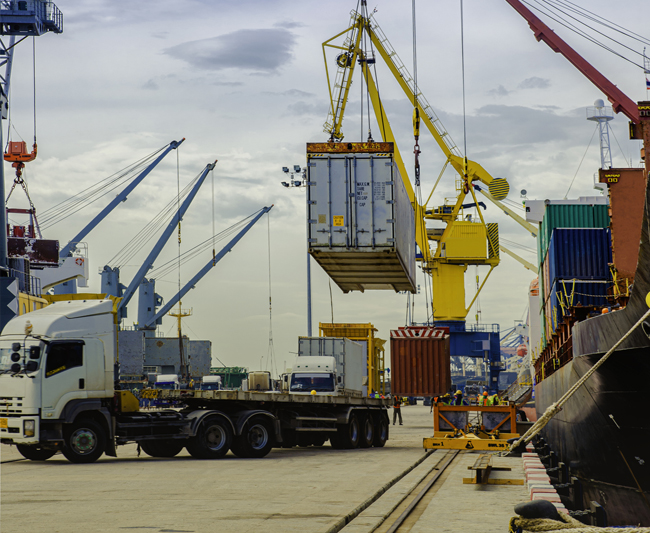
Battery swap for boats
The electric inland ship Alphenaar recently sailed its maiden voyage, from Alphen aan den Rijn to Moerdijk in the Netherlands.
The battery swap landscape is ever-evolving. BSOT is always looking for new technologies and opportunities to explore and pivot toward.
FAQs
Will we have enough Li to make all of the batteries?
In short yes – more than enough. For a more detailed answer, click here. As contingency, there is also a few solid new chemistries coming along that we can pivot to like Sodium-ion.
Is battery swap likely for my car?
It has been explored a few times and struggled in the past due to the cost of batteries and lack of demand. With the increasing use in EVs and with CATL and BYD entering the market with their battery exchange technology we are likely to see more of it but unlikely in the low-density cities we have in Australia. It’s definitely not yet on the radar for BSOT.
Won't hydrogen make batteries redundant?
While hydrogen may have a big part to play in decarbonising industrial processes (like steel manufacturing) it is unlikely we will ever see it used for storing or transporting energy. That said you never know and BSOT will be set up to be able to pivot.
How quickly can a battery be swapped?
Tesla aimed to have it down to 90 seconds for their cars, CATL suggest they can do it in 60 seconds and multiple battery swap scooter tech companies are claiming 30 seconds.
Will 5 minute "fast charging" make BSOT redundant?
This has the potential to be a game changer in a number of EV applications but not in the opportunities BSOT is currently developing. Fast charging requires a huge investment in additional power and distribution infrastructure and dramatically reduces the ability to leverage off cheaper intermittent renewable energy.
A good recent article on the story is located here for further reading.
The key comment is this: “The caveat is obviously BYD needs time to build out its ‘lightning fast charging’ network and [make] it available to more models at more competitive prices,” Lei Xing, a Chinese automobile analyst based in the U.S., wrote in a note. “BYD also needs to solve the issue of grid overload: 1,000 kW charging is equivalent to starting 100 home air conditioners at the same time.”
Get On Board
Get in contact
Let us know what you are interested in and we will be in touch soon.
Sign CA
If you want to be involved and get more detail on our first project, we will send you a Confidentiality Agreement to execute.
Be a partner
We are looking for individuals and organisations to join the team and accelerate the journey.
BSOT is moving fast — powered by a high-performing team, a clear roadmap, and early traction through strategic partnerships and concept validation.